
Real Reform
Fixing primary care requires the imagination to think big.

It’s World TB Day and I’m up in Northern Saskatchewan for a day of TB clinic.

Today, I’m posting about Primary Care Reform in Saskatchewan, but of you’re keen on some TB content, here’s a post on the reality of TB in Saskatchewan today:

and a reflection on the role of Community Health Workers in supporting TB care in Lesotho:
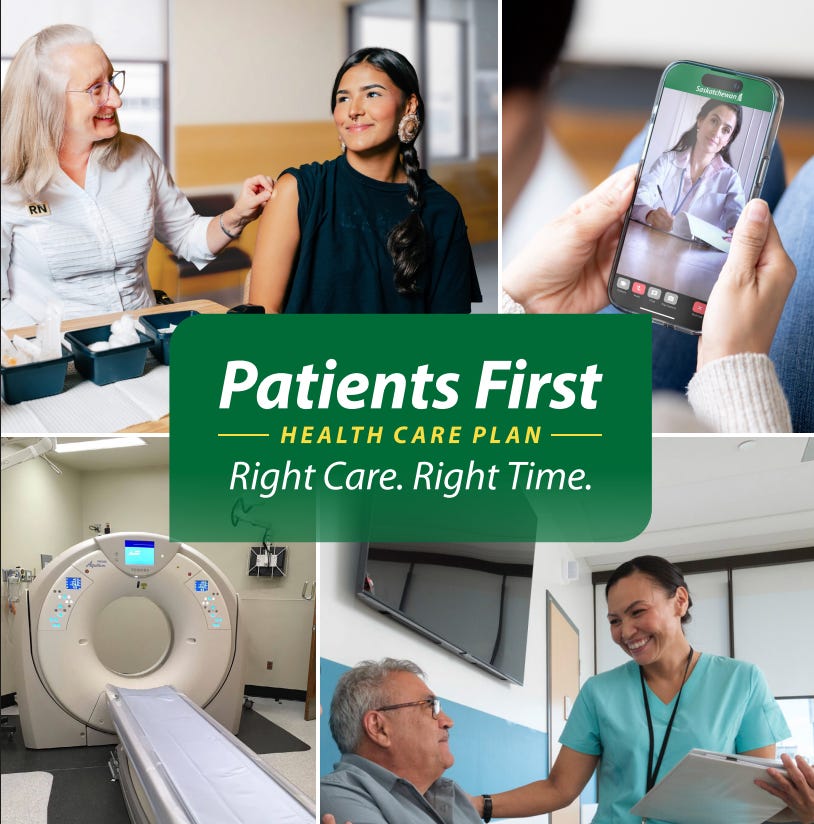
In the lead-up to last week’s provincial budget, Saskatchewan Premier Scott Moe and Minister of Health Jeremy Cockrill released the Patients First Health Care Plan. The broad strokes of this plan are positive. Emphasis on expanding access to primary care, increasing training spots, shortening wait times for surgeries, increasing the number of hospital beds, these are all good things.
And I won’t spend a ton of time on the fact that much of what is in this report, right down to the tagline of “Right Care. Right time.”, we’ve seen before. If you’re interested in that recycling history, check out Opposition Health Critic Meara Conway’s Instagram reel or Tammy Robert’s walk down health reform memory lane at Our Sask. They have valid criticisms; repeated plans without follow-through leave people frustrated and disillusioned. I remember being invited to contribute to a review of Primary Care during this government’s first term. Good work was done and the model proposed was quite promising. Unfortunately, it was shelved in favour of the next shiny thing. In that case, the shiny thing was “Lean,” with the government looking to cut corners as though health care was akin to car manufacturing, instead of investing in humans and building capacity
.
Nonetheless, I don’t think the “fooled me once” critique is the most important. While the fact that previous efforts didn’t pan out may be reason for some skepticism, you can’t disregard the current effort outright. There will be reforms in health care, there will be investments, it is better to engage in trying to make sure they are the best possible. Taking this document at face value I see a sincere desire to improve health care in the province and in particular access to primary health care. That’s a good thing. There is still a need for constructive criticism, and in this case that means pointing out the missed opportunities. With a little imagination, there are readily available examples that can guide a better health care reform.
The biggest problem with the current plan is the emphasis on expanding nurse practitioner-led clinics as the central solution. That’s no knock on the skill set of nurse practitioners. I’m fortunate enough to work closely with NP colleagues who are excellent clinicians and leaders on our team. The problem is that this plan sets NPs up for failure by plunking them into the same situation that hasn’t worked for family physicians.
The primary way that physicians, and under this new model NPs, are paid is fee-for-service. Each patient visit is charged to the government based on the service rendered. This results in some perverse incentives away from the best quality care. For example, a regular clinic visit is assigned a numeric code, for physicians a 5B, and it pays the same amount whether the visit is for a sore throat or a new diagnosis of cancer. As you can imagine, these visits take very different amounts of time, knowledge, and concentration. In essence, the system encourages speedy care of minor problems and the avoidance of complexity. Shifting to salary or mixed payment schedules encourages providers to spend more time at the front end of care, taking the time to address all the issues of a patient before they get out of hand. This plan’s emphasis on NPs billing the government directly just expands and perpetuates the same fee-for-service model, emphasizing volume over quality.
This approach, by doubling down on a flawed model, misses out on real primary care reform. And it does so at a time when real changes are happening elsewhere in Canada and right here at home. The most exciting model currently under exploration is being led in Ontario by former federal Minister of Health, Dr. Jane Philpott. As she described in her book, Health for All, primary health care should be available wherever someone goes in Canada. She describes how, if you live in a neighbourhood or a town, your kids can just enroll in the local school. You don’t have to call around and beg to see who is accepting new students. She asks why it isn’t the same for health care.
We could organize primary care clinics with geographic catchment areas, staffing based on need rather than on what will give the highest billings for the easiest work. It’s a radically different approach, more systemic and planned than we’ve seen before in Canadian medicine, but that’s the point. The current reality is that care is more accessible in the highest income communities rather than where the need is greatest, and even in those better off areas finding care is increasingly difficult. This new model would allow for better allocation of resources, more satisfying and rewarding (financially and professionally) primary care work that attracts providers and, most importantly, better outcomes for patients through well-organized evidence-based care.
Read an excerpt from Jane’s book in this previous post on trust and health care:

Dr. Philpott started clinics in Kingston designed in this locally responsive way during her time as Dean of Medicine at Queens University. She is now leading a province-wide effort to make sure every Ontarian has access to primary care. On a related note, she has also been successful in convincing her province to introduce a single Electronic Medical Record (EMR), increasing the efficiency of care delivery and making sure complete information follows the patient to each clinical visit. These reforms are taking place at scale two provinces over, they are not news to the Saskatchewan Ministry, but similar efforts don’t appear anywhere in this new provincial plan.
The other successful model to be emulated sits closer to home. It always strikes me that when the province gets excited about team-based care we see it looking to examples like Alaska Native Medical Centre or the Crowfoot Clinic in Calgary as though they have invented something new. These are great examples, but Saskatchewan has already been quietly leading the way in team-based care for over fifty years.
I know this because I get to work with that team at the West Side Community Clinic on 20th Street in Saskatoon. The Community Clinic opened its doors in July of 1962, established by a group of doctors who were in favour of the introduction of universal health insurance. At the time, the medical establishment was fighting against Medicare, even going on strike, refusing to see patients for 23 days in 1962. From the beginning, the Community Clinic pushed back against the lone practitioner approach, building up teams of a broad range of health professionals working together to meet the needs of patients.

At West Side, we start the day with a team huddle, with everyone in the building coming together in the upstairs meeting room to talk about the day ahead: which patients might need extra support from outreach, who we haven’t seen in a while and are concerned about, what health-related events – positive or negative – are happening in the community, etc. This sets the stage for the day, with everyone understanding how busy we’ll be and where we need to put our best efforts. Upstairs we have counsellors supporting people with mental health and addictions as well as a team from the health authority supporting people living with HIV. On the main floor is the front desk, the lab, the clinic rooms to see patients, and a pharmacy in the back.
Between patient visits, I spend my time in the Shared Space. Depending on who’s in for the day, we may have three or four family doctors and NPs, a physiotherapist, Registered Nurse (RN), occupational therapist, dietitian, or visiting specialists from Psychiatry or Infectious Diseases.
This is where the teamwork magic happens, when we run into tricky medical problems, or confront the social challenges our patients face, we turn to each other. We share medical knowledge, advice on navigating the system, and lend an ear for the frustrations that have no simple fix. It’s a place of collective learning and support that benefits us as providers and delivers better care. When the physio has a no-show on his schedule and fits the patient who just came to see me with an injured shoulder, when the counsellor can chat about the parent whose adult child has died and arrange to console them in their grief, when a more experienced doc can help demonstrate a tricky procedure, when the RN can take the lead on an in-depth review of a patient’s diabetes or the Medical Office Assistant gets the supplies ready for an injection – professionals can use their best skills and people get faster and higher quality care in one place. It’s messy at times, inevitably so given where we work, but it makes a difference.
The downtown clinic serves a different population and thus provides a different mix of professionals, but the same approach of collaborative team-based care is at work. And that’s the point of a team-based model: what the team looks like is determined by the needs of the community it serves. It’s a full-service approach to delivering the “Right Care. Right Time.” that the province is looking for.
It’s hard to say what the obstacles are to seeing the success of Community Clinics and expanding it across the province. Perhaps the association with the establishment of Medicare carries political baggage, perhaps no one is a prophet in their hometown. Whatever the barrier is, if the province is serious about expanding access to quality care, it needs to be overcome. Real primary care reform, with expanded access and better quality is possible. Combining the community clinic model and the geographic approach proposed by Dr. Philpott are key ingredients to making it happen. They are real, replicable examples of what care can be. Fortunately, experience shows that broad strokes health care plans like what was recently released are not set in stone. There is still time to integrate these ideas and truly put patients first.
I have always wondered why the Blakeney, Romanow, and Calvert governments did not do more to expand and support the community clinic system. It is a model that was ahead of its time and should have been implemented on a province-wide scale, along with salaried doctors and other health care personnel.